


If you’ve tried “marketing to Toronto” before, you’ve probably seen this pattern:
The phone rings.
The inbox fills up.
And somehow… the jobs still feel wrong.
Too far.
Too small.
Too price-sensitive.
Or just not the kind of work you actually want more of.
At InView Marketing (Vaughan-based, serving Toronto + the GTA), we don’t think the problem is effort or spend. Most of the time, it’s targeting— specifically treating Toronto like a single market when it isn’t.
Toronto lead generation works when it respects three things at the same time:
- Your real service area
- The type of work you want (and don’t want)
- How your business actually operates day to day
This article breaks down how we approach Toronto and GTA lead generation when lead quality matters as much as lead volume — using SEO, Local SEO, CRO-focused web design, and PPC when it makes sense.
The Real Problem With “Marketing to Toronto”
Toronto is not one market.
If you target it like one, you’ll get exactly what broad targeting produces everywhere else: busy dashboards, mixed intent, and a lot of wasted time.
When businesses run city-wide campaigns without guardrails, the fallout is predictable:
- Leads coming from outside the service radius
- Low-intent price shoppers
- Neighbourhoods that don’t fit your preferred jobs
- Calls that never turn into booked work

Broad geo settings feel safe.
They usually mean the hard decisions haven’t been made yet.
And those hard decisions are the whole point.
Downtown search behaviour doesn’t match midtown.
The west end doesn’t convert like the east end or Scarborough.
And none of them behaves the same operationally once a job is booked.
Even if two leads use the same keyword, they might be coming from completely different realities:
- Different property types
- Different expectations
- Different budgets
- Different urgency
- Different willingness to book
Better Toronto targeting doesn’t start in Google Ads or SEO tools.
It starts with understanding the business — honestly.
Why One Face-to-Face Meeting Still Sharpens Strategy
We’re remote-first by default. Execution doesn’t require constant in-person time.
But one strategic, face-to-face meeting in Toronto can remove months of guesswork.
What often comes out in person — and stays hidden on Zoom:
- What the owner actually cares about (margin vs. volume, quality vs. speed)
- Subtle reactions to certain services (“We hate those jobs,” even if they sell)
- How a “good lead” is defined in real life, not in theory
- How calls, quotes, scheduling, and deposits really happen inside the business

We’ve had clients insist they wanted volume — until you watch their reaction when a certain job type comes up. It’s not dramatic. It’s just obvious.
Sometimes a business “offers” a service because it’s on the website, but operationally, they don’t want it. Or it used to be profitable, but the market shifted. Or the team is burnt out on it.
A good strategy catches that early.
We don’t need to meet often.
But one meeting can recalibrate the entire targeting plan.
After that, remote execution works better — because it’s grounded in reality.
The Business Targeting Map (Where Lead Quality Is Decided)
Before keywords, ads, or page layouts, we build what we call a Business Targeting Map.
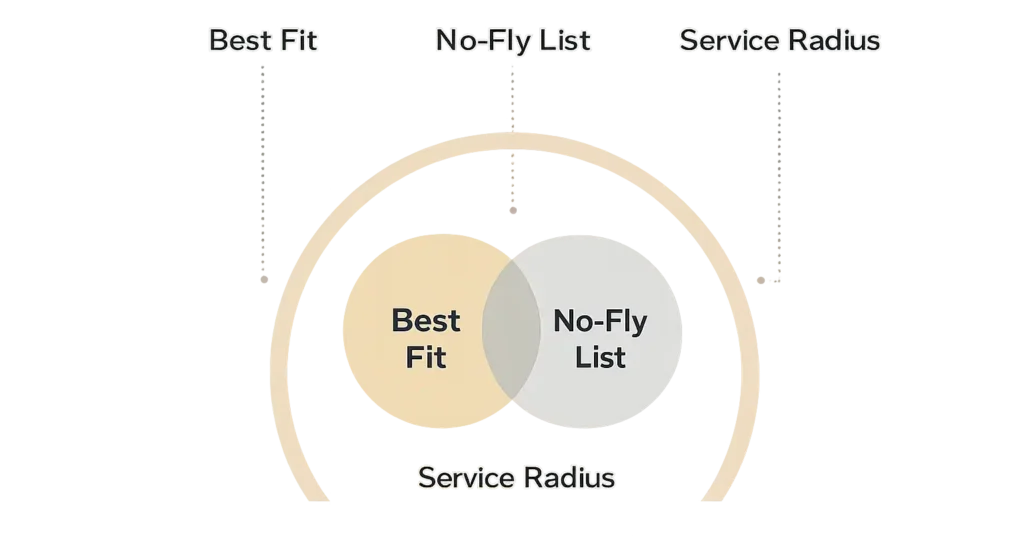
This is where most agencies rush — and where most lead quality problems begin.
It’s not complicated. It’s just specific.
Best-Fit Filters
These define who the marketing is actually for.
Common filters include:
- Services with the strongest margins
- Job types you want more of
- Minimum job or project value
- Lead types that close fastest (or lead to repeat work)
- Ideal customer profile (homeowner, commercial, property manager, etc.)
- Project timelines you can actually support
If a lead looks “good” on paper but consistently creates operational friction, it doesn’t belong in the target set.
This is also where we translate fuzzy preferences into things we can actually execute against. For example:
- “We want bigger jobs” becomes minimum thresholds and qualifying language
- “We don’t want tire-kickers” becomes messaging, negatives, and form structure
- “We’re slammed in summer” becomes seasonal pacing and channel strategy
The No-Fly List
This is where lead quality is protected.
We intentionally exclude:
- Areas you don’t serve — or don’t want to serve
- Job types you no longer want
- Low-intent modifiers like “cheap,” “free,” “DIY,” or “how to” searches
- Optional: time windows, platforms, or sources that consistently waste time
Most marketing tries to attract everyone and filter later.
We prefer to repel the wrong fit before they ever call.
A practical truth: it’s easier to stop bad leads than to “convert” them into good ones. The wrong lead is usually wrong for a reason.
Service Radius Reality
This part is uncomfortable — and essential.
If your team doesn’t want long drives, targeting must reflect that.
If emergency or same-day work only makes sense close to base, ads shouldn’t stretch wider “just in case.”
More leads don’t help if the operation can’t support them.
Marketing should bend to the business — not the other way around.
Toronto Neighbourhood Targeting: Choosing the Right Pockets
We don’t blanket Toronto.
We align marketing with where your best customers already come from — then expand carefully.
This isn’t demographic profiling. It’s operational alignment.
Signals we look at:
- Housing type and density (condos vs. detached vs. mixed)
- Typical service needs (older stock vs. newer builds)
- Travel time from your base and route reliability
- Competition levels (SEO difficulty and CPCs)
- Your actual customer history — where you’ve already closed work

Toronto pockets like downtown, midtown, the west end, and Scarborough all behave differently in search and sales. Pretending otherwise is expensive.
Sometimes the “best” pocket isn’t the fanciest one. It’s the one where:
- You can get there reliably
- You can schedule without chaos
- The jobs fit your process
- You close at a healthy rate
How expansion actually works
We focus on two tracks.
First, we double down on areas you already win in.
We strengthen what’s already working by improving rankings, tightening conversion paths, and using PPC to control volume and quality.
Second, we test adjacent lookalike pockets.
Expansion is deliberate, not random. We test areas that share:
- Similar home profiles
- Comparable buyer intent
- Equal or shorter drive times
- Better margin potential
That’s how growth stays controlled instead of chaotic.
The Execution Stack: SEO, Local SEO, CRO Web Design, and PPC Together
Channels don’t fail.
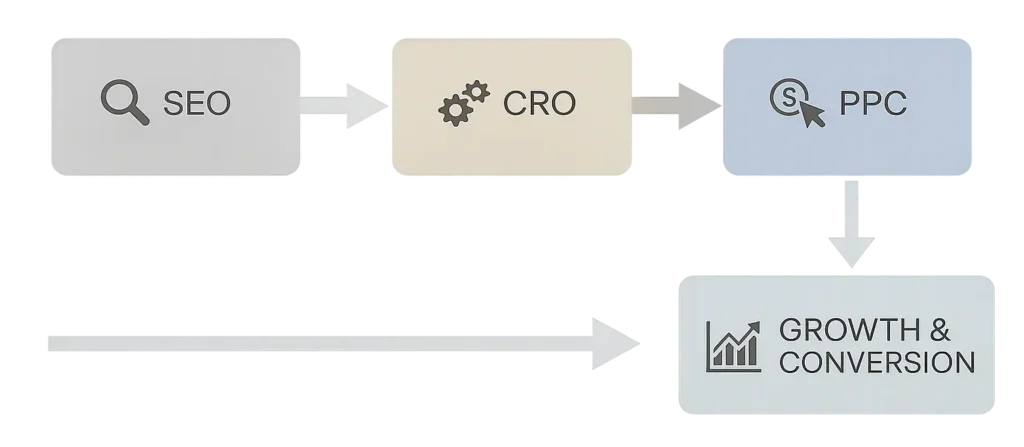
Disconnected channels do.
The best results usually come from treating SEO, Local SEO, and PPC like one system — with a website that’s built to convert the right people.
SEO and Local SEO are the foundation
Long-term lead quality is built here.
- Core service pages designed to rank and convert
- Local SEO focused on real coverage areas (not fantasy maps)
- Reviews and trust signals that support buying decisions
- Supporting content that answers real questions people ask before they book
SEO Services
Local SEO Services
SEO isn’t about traffic.
It’s about qualified discovery — and compounding results over time.
Toronto area pages (done properly)
Area pages only work when they’re honest.
No copy-paste geo pages.
No pretending to serve everywhere.
A good area page is basically a pre-qualification tool that also ranks.
Each area page should clearly communicate:
- Who the service is best for in that pocket
- Common project types you see there (without making weird assumptions)
- Service boundaries and expectations (“Here’s what we do here… and what we don’t”)
- Proof: reviews, photos, short examples, FAQs
- Clear links to matching service pages
If an area page can’t stand on its own, it shouldn’t exist.
And importantly, we don’t build 50 pages “just because Toronto has 50 neighbourhoods.” We build what matches service radius, business appetite, and real intent.
CRO web design as the multiplier
If pages don’t convert, traffic becomes a vanity metric.
Strong CRO design filters before the call ever comes in:
- Clear offers and boundaries (service area, minimums, best fit)
- Click-to-call that’s obvious on mobile
- Fast load times (especially on cellular)
- Proof blocks: reviews, process, FAQs, what-to-expect
Good design doesn’t chase everyone.
It guides the right people forward — and sets expectations early.
PPC for precision and speed
Paid ads are the scalpel.
We use PPC when we need speed, testing, or tight control.
PPC lets us:
- Target specific areas or radii (and exclude others)
- Apply strict negatives and intent filters
- Control day-and-time delivery (when calls can be answered)
- Match landing pages to service and area intent
- Track calls as real conversions — not just clicks
PPC gives immediate signal.
SEO compounds it over time.
“We Don’t Want Every Lead” — How Quality Is Protected

This isn’t a slogan.
It’s an operating rule.
Lead quality is protected through multiple layers:
- Geo exclusions: don’t pay for out-of-area clicks
- Service exclusions: don’t invite work you don’t want
- Negative keywords: reduce low-intent traffic
- Form qualifiers: basic questions that save everyone time
- Messaging: boundaries that attract the right buyers and repel the wrong ones
The result is consistent:
- Fewer junk calls
- Higher close rates
- Less driving
- Better margins
Some businesses worry that fewer leads will slow growth.
In practice, it’s usually when growth becomes manageable.
A Simple Toronto Targeting Example
This structure stays consistent across industries.
Best jobs usually come from
Areas with specific housing types, within a defined drive time, with repeat service needs.
We avoid
Areas outside the preferred radius, low-budget job types, and work that doesn’t fit the process.
We test
Adjacent pockets with similar profiles and equal or shorter travel time.
Execution
We start with PPC in those pockets for speed, then build SEO and local pages to reduce cost per lead over time.
No tricks.
Just alignment.
How We Work
By default, we work remotely. It’s efficient and focused.
When it improves accuracy, we’ll meet in Toronto — usually at kickoff or a strategic checkpoint.
One good meeting early can surface the things that change everything: what you actually want, what you absolutely don’t, and where the business is willing to go to win.
You don’t need weekly meetings.
You need clarity early — and consistent execution after.
That’s how we work.
Frequently Asked Questions
Do you target all of Toronto?
No. We target specific pockets based on service radius, business goals, and past performance. Toronto isn’t one market, so we don’t treat it like one.
How do you stop leads from outside our service area?
We use geo exclusions in PPC, clear messaging on pages, and qualifiers on forms. The goal is to prevent wrong-fit leads — not “handle them better.”
Can SEO really control lead quality?
Yes. SEO influences who finds you and why. Intent-led pages, service boundaries, and strong conversion messaging will shape lead quality significantly.
Is PPC better than SEO for Toronto lead generation?
They solve different problems. PPC is faster and more controllable. SEO is slower but compounds and typically lowers cost per lead over time. Most businesses benefit from using both intentionally.
What if we want to expand into new Toronto pockets?
We usually test adjacent, lookalike pockets first. It’s controlled, measurable, and easier to roll back if quality drops.
Do we need to meet in person?
No. But one strategic meeting can significantly improve targeting accuracy, especially when service mix and geography are nuanced.
Will fewer leads hurt growth?
Usually, the opposite. Better-fit leads close faster, require less admin, and scale without breaking operations.
How long does it take to see results?
PPC can produce leads quickly once tracking and landing pages are in place. SEO and Local SEO typically build momentum over time, but early wins can happen depending on competition and current site strength.
Let’s Map the Right Toronto Leads

If you want more leads from Toronto — but only from the areas and job types that actually fit your business — let’s map it properly.
We can start remote.
And if one in-person meeting in Toronto helps sharpen the targeting, we’ll do it and often recommend it.
No blanket targeting.
No wasted motion.
Just better-fit leads.