


The Compliance Gap Isn’t In The Clinic. It’s In Your Campaigns.
For years, healthcare organizations treated HIPAA as something that lived in the legal department, the IT stack, and the clinical records system. Marketing teams ran campaigns, built lists, fired pixels, and largely assumed someone else had checked the compliance box.
That assumption is proving extremely expensive.
The enforcement landscape has shifted in ways that directly implicate how healthcare brands run their digital marketing. The tools your team uses every day, from the tracking pixel on your paid media landing page to the email platform sending your patient communications, now sit squarely in regulators’ line of sight. Healthcare marketing compliance is no longer a peripheral concern. It is a core operational responsibility.

The Marketing Stack Is Full of Compliance Exposure
Most healthcare marketing teams didn’t build their tech stack with HIPAA in mind. They built it for performance: better targeting, cleaner attribution, faster automation. The problem is that the tools powering that performance were largely designed for retail and ecommerce, not for industries where the data flowing through them is federally protected.
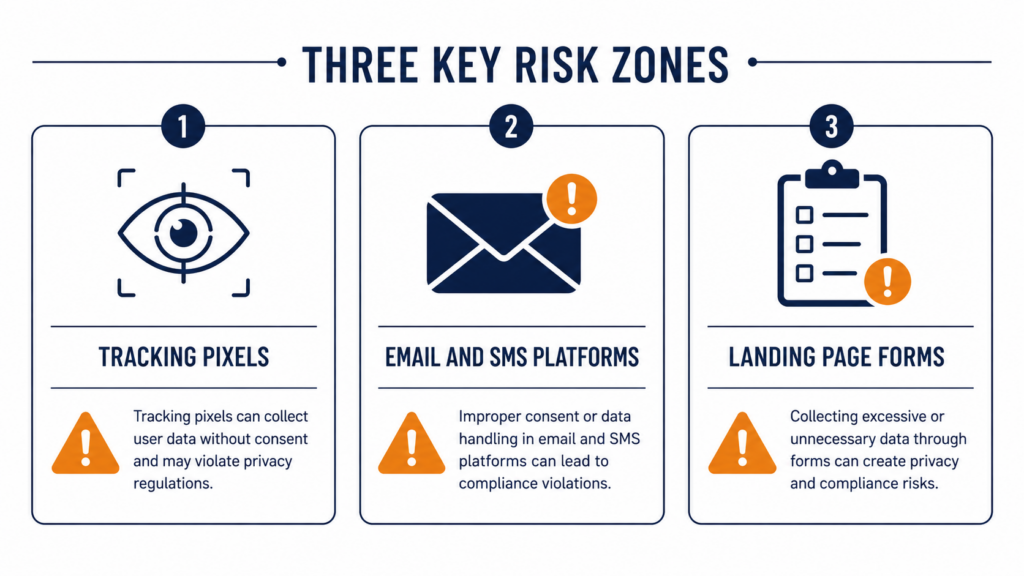
The Meta Pixel is the clearest example of how badly this can go wrong. Meta does not sign Business Associate Agreements, which means any healthcare organization with the standard pixel installed on pages where patient data is present is in violation of the HIPAA Privacy Rule, full stop. From 2023 to 2025, pixel tracking violations cost U.S. healthcare providers over $100 million in fines, settlements, and class action payouts. MarinHealth settled a Meta Pixel class action for $3 million. The University of Rochester Medical Center agreed to pay $2.85 million. Froedtert Health settled for $2 million. These weren’t small operators running rogue campaigns. These were established health systems that simply had a standard piece of marketing code on their website.
Google Analytics carries similar risk when it touches authenticated pages, patient portals, or any form where users submit health-related information. Session replay tools, heatmap software, and retargeting scripts can all create exposure depending on where they fire and what data they capture.
One analysis found that 72.6% of healthcare websites had Google trackers configured, and 11.6% had Meta trackers set to collect form data that could include protected health information. The marketing technology is everywhere. The compliance review, in most cases, is not.
Email and SMS Are Not Off the Hook Either
The same BAA requirement that applies to your analytics and advertising vendors applies to every platform in your communications stack. If your email service provider processes data that could identify a patient in connection with their health status or care, that vendor must have a signed Business Associate Agreement with your organization.
This is where a significant portion of healthcare marketing teams have an unexamined gap. Platforms built for ecommerce and retail brands, popular and capable as they are, were not architected for regulated healthcare use. They don’t offer BAAs. They don’t support the consent management, secure data handling, or audit trail requirements that HIPAA demands.
The OCR collected over $9.9 million in penalties from healthcare organizations in 2024, with a substantial portion tied to failures in exactly these areas: insufficient risk analysis, missing vendor agreements, and inadequate security controls around the channels used to communicate with patients.
Email is still healthcare’s most valuable direct communication channel. It is also, according to a 2025 report analyzing 180 healthcare email breaches, the channel with the widest gap between risk and organizational readiness. Only 1.1% of analyzed healthcare organizations had a low-risk email security posture. That is not a rounding error. That is a systemic problem.
For healthcare brands ready to address their email and SMS compliance properly, the infrastructure question matters as much as the content strategy. Platforms built with BAA support, documented consent management, and proper data handling architecture exist. Moving to one requires both platform knowledge and implementation expertise. Wired Messenger, a certified Customer.io agency partner, specializes in exactly this migration for healthcare and healthcare-adjacent organizations. Their detailed breakdown of what HIPAA compliant email marketing actually requires is worth reading before your next campaign goes out.
Forms, Landing Pages, and the Data You Might Not Realize You’re Collecting
Paid media campaigns that drive to landing pages create another compliance surface that marketing teams frequently overlook. A form asking a visitor to enter their name, contact information, and the health condition they’re seeking treatment for is collecting Protected Health Information, regardless of whether your team thinks of it that way.
The platform hosting that form, the CRM receiving the submission, and any pixel tracking conversions on that thank-you page are all part of the compliance picture. If any of those vendors don’t have a BAA in place, the data flowing through them is exposed.
In 2025, the OCR made clear that its enforcement priorities around web tracking and browser-based data collection would continue into 2026. Failing to govern third-party scripts and tracking tags is now classified as willful neglect under the most serious penalty tier, carrying per-violation fines that compound quickly across pages, sessions, and time periods.
This is not a theoretical risk. It is an active enforcement priority with documented financial consequences.
What Healthcare Marketing Teams Need to Do Differently
The marketing team can no longer outsource compliance accountability entirely to legal or IT. The tools being selected, configured, and deployed are marketing decisions, and the compliance implications of those decisions now follow the people making them.
That doesn’t mean every marketing manager needs to become a HIPAA expert. It means working with agency partners and platform vendors who already are. It means asking whether your email platform will sign a BAA before you migrate your list. It means understanding which pages your tracking pixels should and shouldn’t fire on. It means having a documented vendor review process that treats compliance as part of the evaluation, not an afterthought.
The healthcare brands that are getting this right aren’t doing more work. They’re working with partners who have already solved these problems and built the infrastructure around them.
InView Marketing works with healthcare and healthcare-adjacent organizations to build digital marketing programs that perform and hold up to scrutiny. Compliance-aware strategy isn’t a constraint on good marketing. For brands operating in regulated industries, it’s what separates sustainable growth from a settlement.